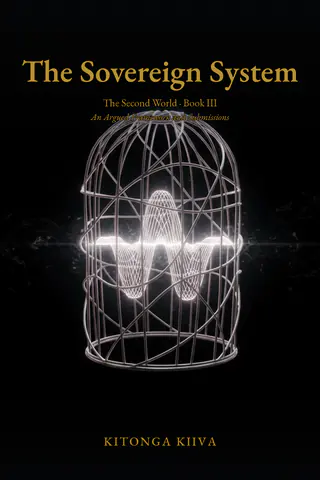
The Second World · Book III · The Argument
The Sovereign System
An Argued Framework and Submissions
There are two registers of meaning. One can be measured, audited and sold. The other passes through no formal channel at all.
Which is precisely why the architecture of modern life keeps mistaking its absence for proof that it was never there. This is the structure of that mistake, and what holding the line against it actually costs.
The second edition adds a fifth part: five submissions that put the framework in front of the cases it would have to survive — a dowry negotiation in a room in Kenya, a theorem tested on its own author, a compression visible in a court’s own written reasons — and a sources section that says, entry by entry, what was read in full and what was not.
This book did not begin as a book. It began as a recognition.
The recognition was this: most of what is called thinking is the system thinking through you. Most of what is called choice is the architecture selecting from the options it has already permitted. Most of what is called self is the residue of repeated interactions with structures whose interest in you is structural, not personal.
There is something else. Something that was there before the architecture began shaping it. Something the architecture cannot reach, because the architecture and that thing are not made of the same material. This book is about that thing. It is about how to recognise it, protect it, develop it, and operate from it.
I call it the Kernel.
Older traditions called it other things. The Gnostics called it pneuma: the breath, the spark, the irreducible centre that the Demiurge could not author and therefore could not control. The mystical traditions named it variously: the heart, the still small voice, the witness. Modern physics, approaching the same territory from the opposite direction, calls it nothing yet, but speaks of standing waves, of coherent oscillation, of signature frequencies that persist through perturbation. George Leonard, writing at the edge of those approaches, called it the silent pulse: a rhythmic signature absolutely individual and yet continuous with everything.
These are not the same concept. But they are circling the same territory. They are all attempting to name what is left when you subtract the system from the self, and finding, against expectation, that something is left.
The Sovereign System is a theoretical architecture for understanding what that something is, how it operates inside larger systems, and how it remains itself when those systems are designed to absorb it.
The cage is the working name for the architecture of capture.
It is not a metaphor. It is a structural description of the layered systems (cognitive, social, institutional, informational) that organise themselves around the suppression, distortion, or absorption of sovereign cognition. The cage is not built by villains. It is built by feedback. Every system that succeeds at maintaining itself is, by the structural logic of its persistence, optimising toward the suppression of inputs that would destabilise it. Sovereign cognition is such an input. The cage is what successful systems do to it.
This is not paranoia. It is cybernetics. A system whose feedback loops have stabilised around a particular attractor will resist perturbations toward other attractors. That resistance, scaled across cognitive, relational, institutional, and cultural layers, is the cage. The Demiurge of the Gnostic tradition is the personification of that resistance: the figure who builds the world that traps because he mistakes the architecture for the truth.
The cage is real and it is mostly empty.
That second sentence is the move. The cage that appears solid is, at the level of its constituents, vibrational pattern: wave forms holding the shape of substance. Leonard’s contribution to this framework is the physics of that observation. Matter is mostly empty space punctuated by probability waves. Institutions are mostly empty time punctuated by ritualised behaviour. Both claim a solidity they do not possess. Both are nonetheless capable of damaging what fails to recognise their actual ontology.
The Kernel was never inside the cage. Not because the Kernel escaped. Because the cage and the Kernel are not made of commensurable materials. The cage is pattern claiming the status of substance. The Kernel is the resonant signature that precedes all patterns.
THE SOVEREIGN SYSTEM · PROLOGUE